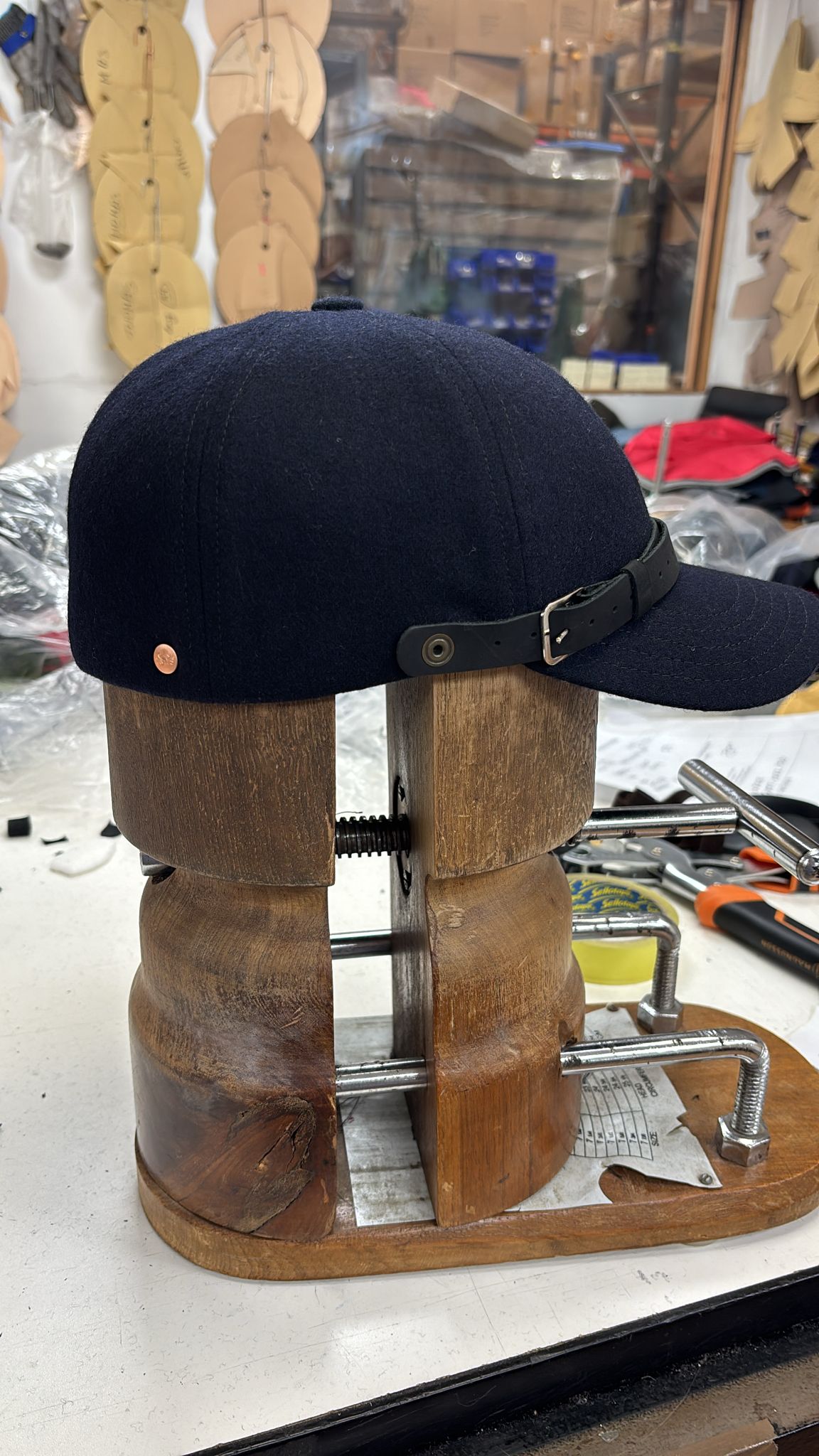
The PIAFEIRA Touring Cap Sample 001 is arriving today. I have been waiting for it for the last three months, and in that time the Touring Cap has moved beyond the initial concept. On the early days of figuring out the Touring Cap, all ideas were on the table – But very quickly my instinct told me I should try to make the best cap possible handmade in the UK.
I found Laird Hatters London and Sample 001 was ordered using notes, measurements, photographs and conversations accumulated during the first weeks of developing the Touring Cap – No technical drawings, no patterns and no specifications. I knew what I was trying to achieve and Laird accepted to interpret my idea and turn it into a cap – “The design is a one of a kind, we have never made a cap like this so it will be completely unique to Piafeira.”
For the last 3 months, I kept working. I started learning how to work leather, making my own chinstraps. Making Touring Cap prototypes. Giving shape to my idea, testing colours, materials, hardware and making measurements. I started testing the prototypes and started a trial program we now call Run Trials.
I was introduced to Bill Vero, the legendary helmet maker – Bill offered me access to his archive. His assessment of the prototypes was this – “It’s a simple idea. But it’s a good advancement within a sporting cap, for a particular use. You’ve got good materials. You’ve got a good idea. And it’s something slightly different in what could be a very competitive market. But I am sure you could find a niche… And it’s a marketable product. It might not be a huge seller, but something you could manage yourself.”
I was introduced to Ollie Leston, grandson of the legendary Les Leston – Ollie completed the first Run Trial, on a road trip to France with his girlfriend – His reaction to the Touring Cap was – “The cap looks very good with the Chinstrap. It works even if only as a fashion object”.
I was introduced to Giuseppe Savoca by the British Hat Guild, who is now collaborating on the Creative and Product Development of the Touring Cap. His first reaction to the project was – “Your project sounds very interesting. I have always enjoyed the intersection between heritage craftsmanship, functionality and contemporary design, and I can certainly see how the world of classic motoring could inspire a distinctive headwear product. Thank you for sharing the concept and the images. It is always exciting to see a project at its early stages and to understand the thinking behind it.”
There is a strange feeling when I think about how much the project has developed since Sample 001 was commissioned. Somehow it could be considered outdated. But I am starting to see it more as a time capsule – Evidence of what the Touring Cap was before specifications and prototypes. Something like the Touring Cap 00.


